
Cultural Notice:
Aboriginal and Torres Strait Islander visitors are advised that this page contains the name, story, images and artwork of a senior Fitzroy Valley elder who has passed away. It is shared with deep respect for his family and Country.
______________________________________________________________________________________________
Alec Forrest:
In 2003 Alec’s Story was published by the Kimberley Language Resource Centre –
My review:
Alec’s Story is an auto biography by Alec Forrest, told in Walmajarri and recorded in 2000 by Olive Knight for the KImberley Language Resource Centre at Fitzroy Crossing, WA, Australia. It was later translated to English by Olive Knight and produced as a book and published in 2003 with the Walmajarri audio tape.
Alec Forrest was a Wallmajarri man born Jukutany in the Great Sandy Desert c 1930 at Kaninggarra, a waterhole west of Lake Gregory. His country was in the desert, adjacent to the Ngurrara claim group that painted on the Ngurrara Canvas
Told over 19 short chapters Alec’s life is condensed to an eloquently described life from being born in the desert, losing his father who was shot for killing cattle, living the life of a nomad child, describing bush tucker, growing up on GoGo Station to his harsh experiences living and working on a vast number of Kimberley cattle stations and spending years in the Derby Leprosarium.
Proud of the skills he learned working cattle, having 5 or 6 languages under his belt Alec’s stories will make you cry and make you smile. Alec Forrest is a philosopher and gifted story teller. In his later years he sold paintings through Mangkaja Arts Resource Centre, Alec’s elaborate stories continued in his paintings. The story is for the descendants of Jukutany to know and remember but anyone reading this book will be enriched by the experience. It is unlikely that any hard copy of this book is available for sale so I have reproduced it as a www page with permission. (Ford 2016)]
I had the good fortune of working with Alec (Longfella) Forrest between 2003 and 2006. He painted his stories on canvas and they were eloquently described by him. He was a reluctant painter in that he was not prolific in quantity due to an inherent mistrust of kartiya (white people). He would paint new paintings as the older ones got sold. He was very thoughtful about his subject matter and each of his works is unique in that way, unlike a lot of indigenous artists who paint the same subject over and over again.
I was trying to encourage Alec to make a painting for each of the chapters in his book “Alec’s Story”. He was keen on the idea but reluctant to get too far ahead of himself. “See how these go” he said. I was captured by his unique style and eloquent stories. “If this (Junjarti) isn’t sold by the time I leave, I will buy it”, I promised him. He was not popular enough for a mass of enquiries to suddenly erupt but his work was GOOD! One of his later paintings, I consider this to be one of best and a more resolved version of the painting “Darnku Country” purchased by the Australian War Memorial in 2003 because of it’s reference to WWII.
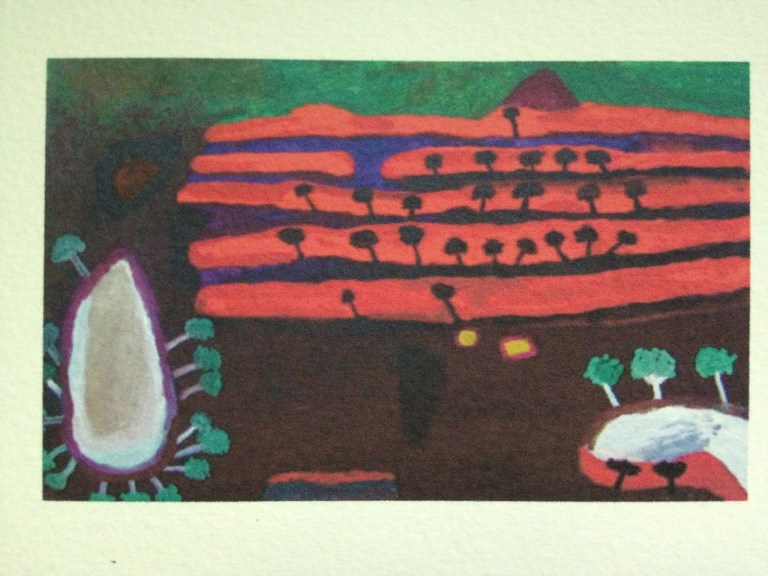
The work I was looking at was this painting:
“Junjarti” – 78cm x 121cm, 2005
“This is a well near a soak water called Junjarti. At the top is a big warla (lake) in the jilji (sand dunes). There is a big hill that you have to go across sideways.This is the desert. That big black hill, Sam Thomas lived there with a big mob of sheep. He had desert blackfellas working with him.We got the timber for the well at Junjarti from that hill. This was during the German world war (WWII). I was a kid working with my brother. The trees on the jilji are desert walnut, good tucker and good timber.The waterhole at the bottom right is Nargarri. We lived there. The water is only there for a little while after the rain. It is like a swamp really. Good water after the rain. We camped there. We built a well there but the water was too salty. We found good water on the other side, near the black trees at the bottom. The swamp( bottom left) is another good place to camp early in the year. This is all desert, all around here. No creek, no billabong. Just soak water and swamp after the rain.The white trees are snappy gum. We used to camp all around here when I was a kid with my mother and father. I still remember this place.”
Alec’s Story:
2003 -Kimberley Language Resource Centre.
Reproduced by kind permission of Kimberley Language Resource Centre , Fitzroy Crossing WA Australia.(2015)


